California
What Happens If Your California Mobile Home Has an Unpermitted Addition?
devs
Learn how an unpermitted mobile home addition in California can affect safety, value, financing, park approval, and your options when…
Read article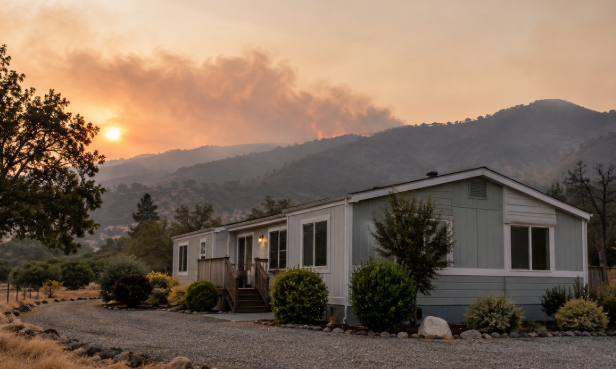
Yes. Wildfire insurance problems can make it harder to sell a mobile home in a California wildfire area, especially if your buyer needs financing. A home that is difficult or expensive to insure may have a smaller pool of qualified buyers, even when there is nothing physically wrong with the home.
We see this issue most often as another layer in an already unusual mobile home sale. The home may be in a park, on private land, titled as personal property, or attached to land as real property. Add a high-fire-risk location and an insurance question can suddenly become part of the buyer’s financing decision.
That does not mean the home is unsellable.
At Mobile Homes 4 Cash, we buy mobile and manufactured homes throughout California, including homes in areas affected by wildfire risk. Understanding where insurance creates problems makes it easier to decide whether a traditional sale or a direct cash sale makes more sense.
A buyer generally looks at a mobile home based on price, condition, location, lot rent, and whether the home works for their living situation.
A financed buyer has another party involved: the lender.
If the buyer’s financing requires acceptable property insurance before the loan can close, trouble finding coverage can delay the transaction or reduce the number of buyers who can realistically purchase the home.
That creates a situation where the seller may have a perfectly usable manufactured home and an interested buyer, but the deal still has another hurdle to clear.
California’s insurance market has been under pressure in wildfire-prone areas for years. The California Department of Insurance specifically publishes guidance for owners who have difficulty obtaining mobile home coverage and points consumers toward the California FAIR Plan when coverage is unavailable through the regular insurance market.
The state has reported signs of increased insurer participation in 2026, which is encouraging. Still, availability depends on the individual property, insurer, location, risk model, and coverage being requested.
This distinction matters.
Living in a California wildfire area does not automatically mean every insurer will reject the property.
California has also clarified that CAL FIRE’s Fire Hazard Severity Zone maps do not directly set insurance rates or determine whether an insurer will write a policy. Insurance companies use their own underwriting information and catastrophe models when evaluating risk.
That means two homes in the same general region can have different insurance outcomes.
The home’s construction, age, condition, roof, surrounding vegetation, nearby structures, fire-hardening improvements, community-level mitigation, and the insurer’s own underwriting rules may all enter the picture.
For a seller, the practical lesson is simple: do not assume your home cannot sell just because you live in an area people associate with wildfire risk.
Find out what the actual problem is first.
Insurance and financing often become connected during a traditional sale.
A buyer who needs a loan has to satisfy the lender’s requirements before the lender funds the purchase. Manufactured-home financing already tends to be more specialized than financing a conventional site-built house, particularly when the home sits on leased land rather than land the homeowner owns.
An insurance issue can narrow that buyer pool further.
For example, you could have a buyer who likes the home, qualifies for the park, agrees with the price, and then discovers that the available insurance is more expensive than expected or doesn’t meet the lender’s requirements.
That can change affordability quickly.
A buyer paying cash does not have a mortgage lender making insurance approval a condition of funding. The buyer may still want or need insurance for their own reasons, but there is no financed-buyer loan contingency creating the same closing hurdle.
That difference is one reason direct cash sales can make sense for some California homes that are difficult to finance or insure.
The FAIR Plan exists as an insurance option of last resort for California property owners who cannot obtain appropriate coverage in the traditional insurance market.
Mobile homes can qualify for coverage. The California Department of Insurance specifically discusses the FAIR Plan in its mobile home insurance guidance.
There is an important limitation, though.
FAIR Plan coverage is primarily basic fire coverage. It is not automatically equivalent to a standard comprehensive homeowners or mobile-home policy. Some property owners purchase a separate Difference in Conditions policy to fill coverage gaps.
So if a prospective buyer says, “I’ll just get FAIR Plan insurance,” that may be part of the solution, but it should not be treated as a guarantee that every lender or buyer requirement has been solved.
The buyer should confirm available coverage and lender requirements directly with the appropriate insurance professional and lender.
Potentially, but there is no simple statewide percentage you can subtract from the home’s value.
Insurance becomes a value issue when it changes what buyers are willing or able to do.
If similar homes in the area remain easy to insure and buyers are active, wildfire exposure may have little practical effect on your sale.
If buyers repeatedly struggle to obtain acceptable coverage, the effect can be much more noticeable. A smaller pool of financeable buyers usually means less competition for the home.
The land situation matters too.
A manufactured home on owned land is a different asset from a mobile home sitting on a rented space in a park. Age, size, condition, land ownership, local demand, and lot rent can all have a larger effect on value than wildfire insurance alone.
If you’re trying to establish a starting point, use our free mobile home value calculator. It factors in the home’s age, size, condition, location type, and whether land is included.
Then compare that estimate with what actual buyers are willing to pay.
Insurance does not replace the park approval process.
If the home stays in its current community, a new resident will generally need to meet whatever approval requirements the park has in place.
That means a traditional buyer may need to clear several separate hurdles: buying the home, securing any necessary financing, obtaining insurance, and receiving park approval.
If the home is in a community, review our guide to selling a mobile home in a park before assuming insurance is the only issue affecting the transaction.
Lot rent also matters.
An expensive insurance quote added to high monthly space rent can change the buyer’s total housing cost enough to affect what they are willing to pay for the home itself.
Look at the whole transaction rather than isolating one expense.
California has created its Safer from Wildfires framework to recognize property and community wildfire mitigation.
Actions identified by the state include things such as maintaining an ember-resistant area around the structure, using fire-resistant vents, clearing vegetation and debris, improving roof fire resistance, and completing other property-level safety measures.
California insurers must recognize qualifying mitigation through wildfire-related insurance discounts.
If you’ve already completed wildfire-hardening work, keep the documentation.
Receipts, photographs, inspection records, certifications, and information from your park or community may be useful when an insurer evaluates the home.
Do not spend thousands of dollars on improvements solely because you assume they will increase the selling price, though. Find out what an insurer or prospective buyer is actually concerned about before investing heavily in work you may not recover in the sale.
Start by figuring out whether there is a real insurance problem or just a concern that one might exist.
If you currently have coverage, keep your policy information and any recent renewal or nonrenewal notices. If an insurer has identified specific property conditions that affect eligibility or pricing, keep those records too.
Next, look at the home itself.
Document recent roof work, vegetation clearing, exterior improvements, or other wildfire-mitigation work you have completed. If the home is in a park, ask management whether there are community fire-safety programs or requirements that a prospective buyer should know about.
Then consider your likely buyer.
A move-in-ready home with owned land may still be worth exposing to the traditional market if buyers in the area are securing financing and insurance without major problems.
A home with insurance trouble, deferred repairs, an older build date, or a complicated park situation may attract a much narrower group of retail buyers.
That is where comparing selling options becomes useful.
We buy mobile and manufactured homes directly throughout California. We are not listing the home for you and waiting for a retail buyer to get financing.
You tell us about the property, including whether it is in a park or on private land, its age, size, condition, and anything unusual about the situation. We review those details and put together a no-obligation cash offer, often within one day.
You can sell your mobile home directly to us as-is, without making repairs or preparing it for traditional showings first.
More tips on selling your mobile home.
Learn how an unpermitted mobile home addition in California can affect safety, value, financing, park approval, and your options when…
Read articleDoes a Roseville location raise your mobile home’s value? Learn how Placer County demand, lot rent, land ownership, condition, and park…
Read articleRequest a free, no-obligation offer today and we'll get you a number fast, often within one day. Tell us about your home and we'll do the rest, right down to bringing the cash to your door at closing.